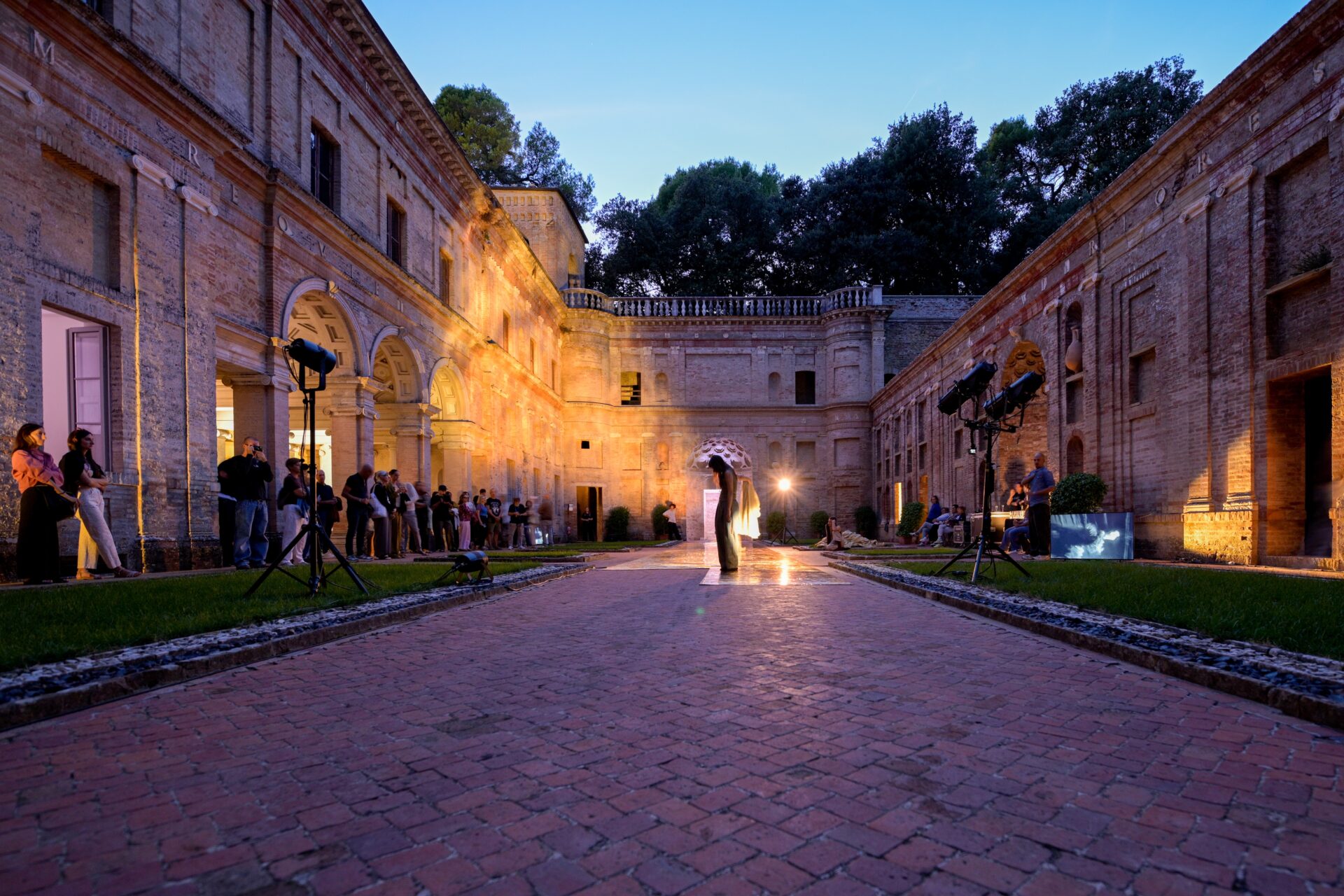
We enter the splendid Renaissance garden of Villa Imperiale in Pesaro as the sun sets, the performance already an hour underway. “goldroom”, presented at Hangartfest 2026, the festival directed by Antonio Cioffi, is the title of the piece, the second chapter of the Overlook Hotel project, inspired by the imagery of Stanley Kubrick’s The Shining.
goldroom - Villa Imperiale, Hangartfest
Foto: Maurizio Cocci
It is the work of the Ravenna-based company led by Marco Valerio Amico and Rhuena Bracci, a visual essay with Carolina Amoretti, Marina Bertoni, Rhuena Bracci, Andrea Dionisi, Agnese Gabrielli and Marco Maretti, which embraces the spectator through a multisensory dimension and a remarkable perceptual architecture.
On the ground, a long glossy trail cuts across the perfect geometries of the Della Rovere garden, and it feels like standing on the board of a great collective game, where each of us is both pawn and player. You enter in order to move, to shift position while the action unfolds, and you immediately realise you are in another dimension: there is no stage, and the few chairs are scattered here and there. Dancers and audience breathe the same changing light together; spectators no longer simply watch, but walk and can choose different vantage points.
goldroom - Villa Imperiale, Hangartfest
Foto: Maurizio Cocci
The perspective shifts, the perception of things shifts, the emotions shift: nothing ordinary, nothing predictable. We are in an alternative setting that offers a performance to be read as the evolving expression of a line of research spanning some sixty years, the latest link in an artistic chain that took shape between the 1960s and the 1980s.
Starting from the New York Happenings, where the audience becomes part of the action, from Grotowski’s laboratory theatre to the Living Theatre, which also brought its experience to the theatre of Santarcangelo, the festival has continued over time to programme events with an innovative matrix. Many lines of research were pursued in those years, and the present writer had the chance to live through a prolific period that left its mark.
It is worth recalling that Santarcangelo dei Teatri had become the nerve centre of experimentation and of the interplay between temporary architecture, urban space and the performing arts. In the 1980s, the Festival had distinguished itself precisely by hosting and commissioning installations, street theatre and participatory performances able to break with established patterns and tradition. These were the years of proposals, concepts and installations linked to figures such as Vito Acconci, while environmental and relational performances were sweeping across Europe.
The roots of goldroom can also be traced to the lessons of Marina Abramović and Pina Bausch: the audience, at first watching, then becomes a participant and finally an integral part of the work.
So, in gruppo nanou’s work, it is the audience who inhabits the piece, who experiences the dance through observation as well: the spectator is called upon to be present. Each person remains themselves within the scene and acts independently, while the dancers themselves move through the space as if no one were around them. At times they brush past one another in a flash of interconnection, and yet each remains alone with themselves.
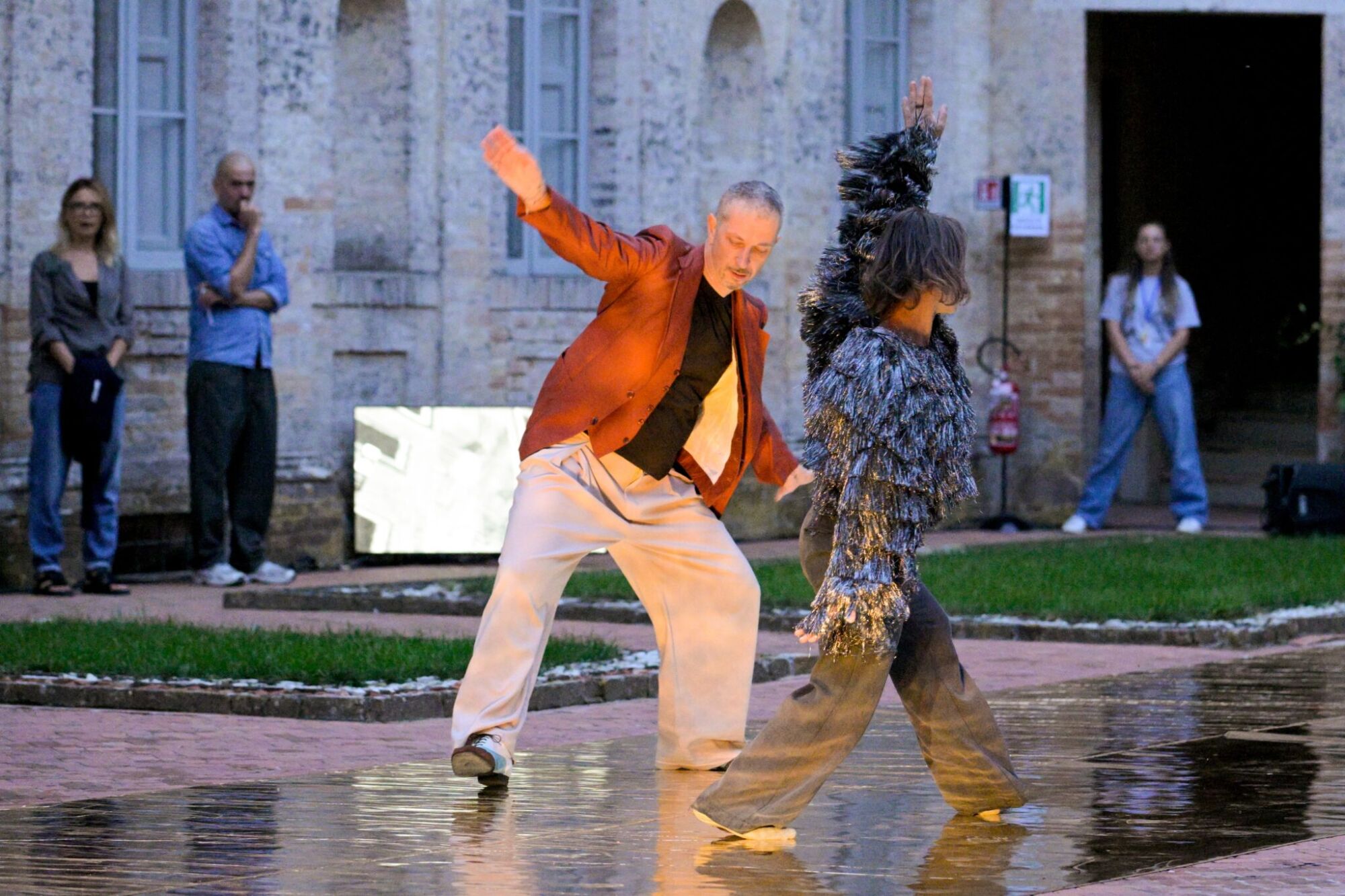
Someone suddenly shifts position and carries on with their action as a mover. One dancer reaches the loggia, where a wall hosts images captured live from reality alongside pre-recorded material, together conjuring an evanescent time and working through delays and presences that create a temporal short circuit. Another wears a fringed jacket that accentuates her movement; she stops, and her gaze crosses the space like a ghost.
goldroom - Villa Imperiale, Hangartfest
Foto: Maurizio Cocci
A dancer takes on an estranged demeanour: he stands before a wall, as if seeking shelter from everything and everyone. He wears an amaranth jacket and moves convulsively within a choreography designed to interact with sound, light and memory, in a whirl of events that exude enchantment.
Everything seems suspended. The omnivorous, ubiquitous nature of time hands us its very elusiveness. Artificial intelligence also plays a part, through algorithms able to manipulate time and space in real time. An intervention working on loops, slowdowns and layered sound and image, transforming the perceptual system. The aim is to create a spatial and temporal elsewhere.
The visual and sensory transfiguration of the space is set to the rhythm of the lighting by Marco Valerio Amico and Lucia Ferrero, the stage device created in collaboration with the architecture studio Denara, and the original score by musician Bruno Dorella.
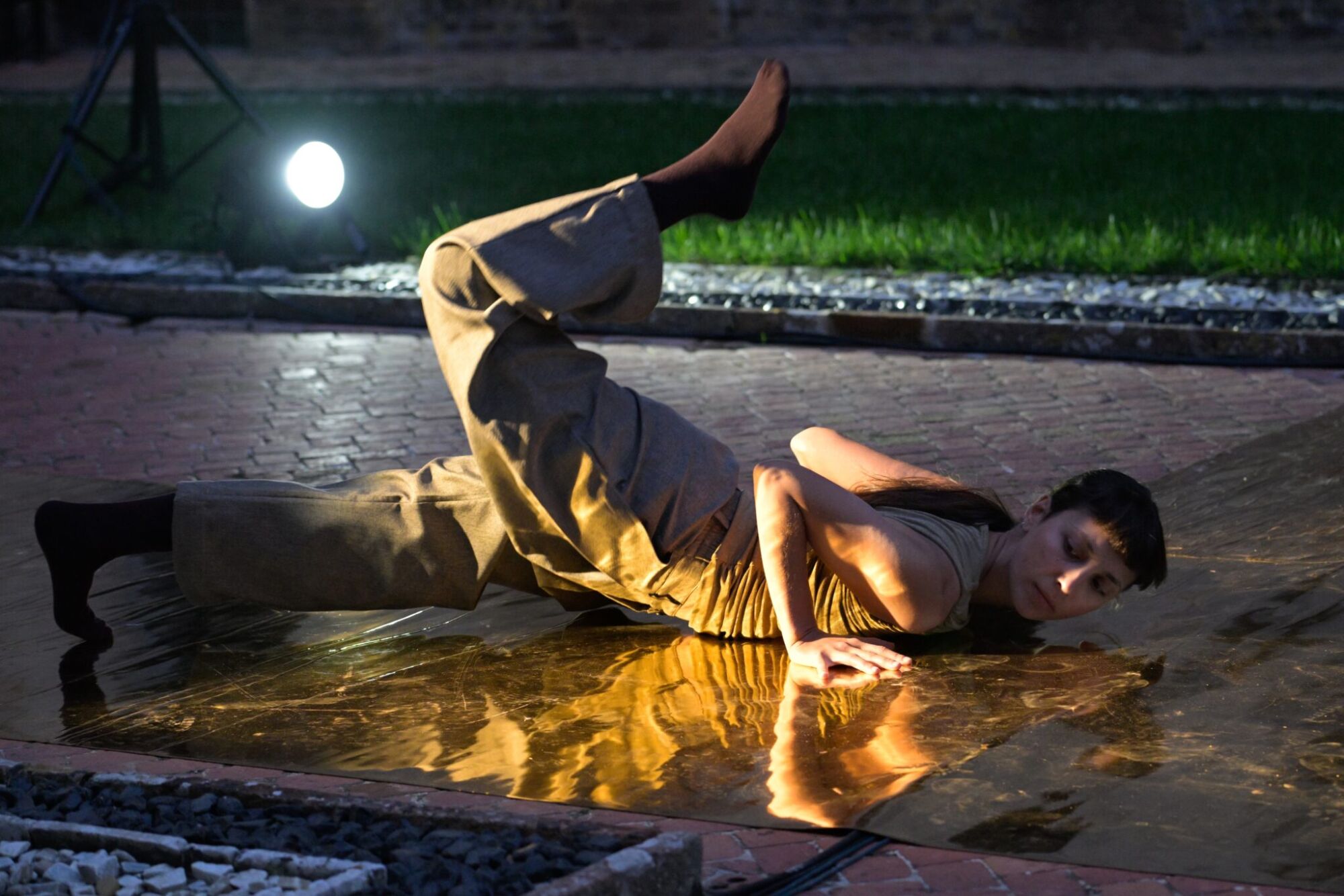
Scattered across the ground are golden fabrics and blankets, golden like the ballroom of the Overlook Hotel in The Shining: a gleaming, flawless room, yet inhabited by ghosts. Here the blankets, in which the dancers take turns wrapping themselves in search of shelter and an embrace before casting them off, become fabrics that resemble unmade beds, steeped in memories able to make an inner tangle visible.
All that has been and all that remains becomes a metaphor for memory. Time, understood as unstable matter, sustains within this singular kaleidoscope a narrative of the ghost-body and of cinematic aesthetics, in which the imperfect processes of human memory come under scrutiny. Actions take shape, break off and return as discontinuous fragments.
Dasein, grasped in its utmost possibility, is time itself, and not in time. We find ourselves immersed in a dimension where the performers’ actions settle, build up in layers and then dissolve, only to begin again in another way, somewhere else.
The dancers take turns in the space. Their movements, now slow, now more convulsive or repeated, inhabit a place of heart-rending beauty. They remain wholly autonomous, like ghosts in a night watched from afar by the moon. They are evocative presences weaving memories of distant places, places marked by an oxymoron of pure intensity, dislocation and wonder.
The golden fabrics are moved and inhabited, feeding a continuity that is, at the same time, also disconnection, within a collective dance in which the individual takes centre stage. The solos repeat and then change, a metaphor for eternal becoming and the transfiguration of an elusive reality.
The musical rhythm sets the pace and enters the bodies of those inside that life: the flesh vibrates, and participation is no longer merely visual. A dancer skips lightly, another seems to be searching for something, picks up a stool, sets it down, then takes another. Unreal figures, and yet real.
A flickering light illuminates the breath of those who dance and the thoughts of those who watch. People move about: some talk, some drink, some take photographs and transform the scene. We remain enveloped in a sphere of light, sound and movement, in an eternal hallucinatory present, where the dancers’ bodies lose their identity and seem like spectres feeding on layers.
The continual exchange of garments, at times lighter, at times heavier jackets, underlines and reinforces this, transforming the bodies as if they were in limbo, suspended between matter and thought, in a dimension that closely mirrors the dramaturgy of the director of The Shining.
When everything that happens takes place in time, an invisible light illuminates the path of this journey and leads us to reflection: the light of art. Art as a key to inquiry, able to grip us deeply and to move beyond limits and boundaries, finding its matrix in intuition and its raison d’être in freedom.
Art, in which everything is possible and which is, in Hegelian terms, the realisation of spirit. Art that lets us enter the mystery of things, the embodiment of a thought. In Pessoa’s words, a journey into the depths of things and back. Art which, like dreams, has the power to erase time and space, allowing us to live as real what is unreal, what has been and what is yet to be.
In the end, everyone sees what they wish to see, feeds on what they feel and takes away what they find, something that perhaps was already within them. For a performance like this becomes liberating: mystery envelops the spirit, and the work in the making allows us to look within ourselves by looking outward.
It is dark when a garden gate opens, the signal agreed with the organisers telling us it is time to make way for another group. And so we carry with us the lightness and intensity of an experience, reminded that there are truths still waiting to be discovered.
When we heard someone say, «It’s all beautiful, but what is there to understand, really?», the answer seemed to hang suspended in the very space of the performance.
Perhaps nothing, perhaps everything. And that’s no small thing.


