“The stage is not decoration. It is a function where sound, light, and body intertwine. It is the house we choose, inhabit, and open when we invite someone in.”
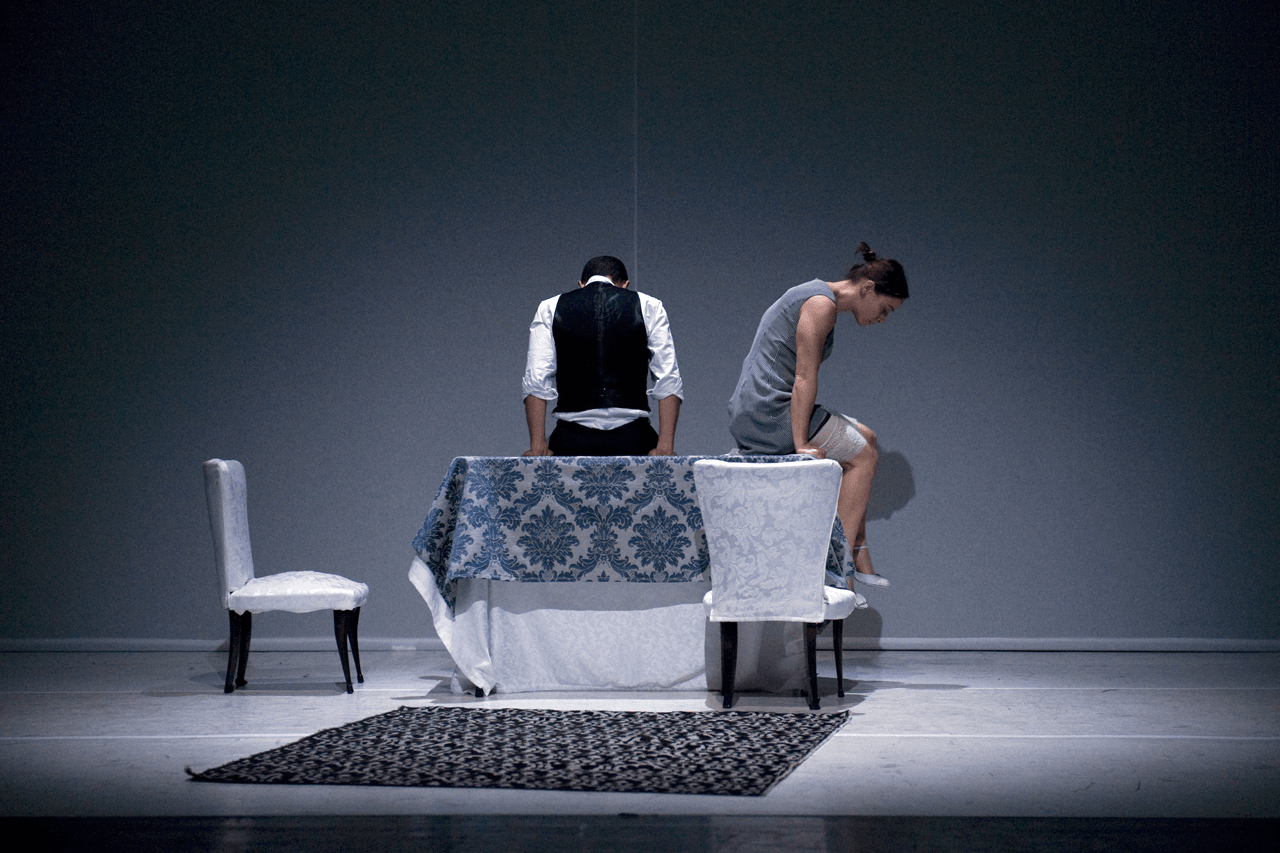
Motel - First room
Photo: Laura Arlotti
Ravenna is an extraordinary city. Most of us have been there at least once in our lives, yet without truly paying attention. And so, when we have the chance to return, we find ourselves irresistibly captivated: perhaps because, somehow, we sense we are in what was once the capital of a vast empire; perhaps because we feel we are walking the same streets crossed over centuries by great artists and historical figures; or perhaps because at every step a different horizon opens before our eyes, every turn revealing an unexpected jewel set within this living fabric, as if to preserve its beauty.
It is no coincidence that one of the most original and visionary companies on the Italian scene is based in Ravenna: gruppo nanou, or simply Nanou. More than twenty years after its founding, the company remains unique within the national—and not only—landscape, thanks to its ability to move beyond the conventional form of performance and its habits, giving rise to a theatre of visions, living installations, and inhabited spaces, where scenography and light play a central role.
We met its founders, Marco Valerio Amico and Rhuena Bracci, immersed in the preparation of their new work goldroom, the second chapter of the Overlook Hotel project. The piece will be presented in preview in Milan at BASE on May 23 and will premiere in early June in the spaces of the Mercato Coperto in Ravenna, as part of the 37th edition of Ravenna Festival. Before that, Nanou will present the previous chapter, redrum, on March 21–22 at the Auditorium Santa Cecilia in Perugia and on April 29–30 at Cango (the National Centre for Dance Production directed by Virgilio Sieni).

Motel - Second Room
Photo: Laura Arlotti
Can you tell us how Nanou came into being? And above all: how has it managed to survive in these difficult times for artistic research?
Rhuena: I’ll let Marco answer the first question, since everything began from his initial impulse—his necessity. We survive by turning necessity into virtue, and limits into a stimulus, in every sense: creatively, administratively, and in our relationships with each other and with our collaborators. There have been—and still are—periods when recalibration is needed, when we look at ourselves and ask whether that necessity is still alive and whether it can still engage productively with the difficulties. Often, meeting collaborators who are genuinely willing to follow us—really get into it with us—in the research is what makes the difference.
MV: We started in 2004. I was very critical of what surrounded me and wanted to see whether I could give form to what I had in mind. I brought Rhuena and Roberto (Roberto Rettura, ed.) into this gamble, each with their own skills and their own body. That’s how Nanou came into being: a collective body, a living synthesis of those who pass through it and build it over time. Today, this shared artistic identity is shaped—alongside the two of us—by an ongoing collaboration with Carolina Amoretti, Marina Bertoni, Andrea Dionisi, Bruno Dorella, Agnese Gabrielli, and Marco Maretti.

Motel - Second Room
Photo: Laura Arlotti
Nanou’s imagery draws extensively from cinema—why this connection?
Rhuena: I think the connection with cinema emerges more clearly in how the work is communicated, but it holds the same weight and presence as the relationship with photography, visual art, “music,” and so on. I’m not directly involved in Nanou’s communication, but perhaps this stronger association with cinema—more evident than others—has to do with how easily it can be conveyed and how quickly it can establish a shared imaginary… a suggested landscape on which viewers can build their own experience.
MV: From cinema we have always drawn a compositional reference. A certain kind of cinema that works with direction, cinematography, editing, and sound as elements in dialogue, without hierarchy, in order to build forms capable of moving beyond genres. I’m interested in that idea of composition as architecture. Turning to cinema—as to visual art—means searching for tools for the language we practice, and making what is improper, heterodox, fertile. And then there is a simple fact: films can be rewatched, studied, analyzed. Their reproducibility makes them an ongoing laboratory.

Strictly confidential
Photo: Zani / Casadio
How do you work on the scenography of your pieces, from conception to realization?
Rhuena: Ah! There’s also the pleasure and fun of quickly gathering—during improvisation and production sessions—debris, remnants, objects, clues, other people’s garments from the rooms adjacent to the rehearsal spaces. Alongside this, there is a process of refinement and selection in relation to the imaginary, to the landscape I mentioned earlier. In the end, these two layers are sifted through, sharpened, and what remains are the scenes and objects that already carry a stratification of meaning.
MV: I think it’s important to address the personal contribution and the mutual exchange that occur when there is a scenographer or an artist involved—such as the green room in Strettamente confidenziale by Paola and Giovanni (Paola Villani and Giovanni Marocco, ed.), the cube in the third Room by Giovanni Marocco, or our relationship with Alfredo (Alfredo Pirri, ed.), who is a visual artist.
MV: The stage is space, and it is body, just as the body is for choreography and vibration is for sound. We understood this from the very beginning. Scenic elements must become choreographic material, generative space. The furnishings of Motel, our first trilogy—created scenically with Antonio Rinaldi and Giovanni Marocco—shaped the body and altered its behavior. The parallelepiped in Sport, developed with Claudio Angelini of Città di Ebla, made it possible to construct a suspended, airborne body, as in artistic gymnastics. The space conceived by Alfredo Pirri in Paradiso determined both light and bodily action: a reflective surface crossed by audience and dancers, where the parameters of above and below dissolve, and balance shifts. The stage is not decoration. It is a function that interweaves sound, light, and body. It is the house we choose, inhabit, and open when we invite someone in.

redrum
Photo: Zani / Casadio
Experiencing one of your works means, in a way, becoming part of it—entering a private, intimate dimension. What role does the spectator play within Nanou’s dispositif?
Rhuena: My primary attempt at the moment is to shorten the perceptual distance between viewer and performer. It is a coming together, not only through the eyes and the mind. The entire structure moves in this direction. We ask for a closeness to the performers—a subtle closeness, not merely spatial. The aim is to share the same state, not just the same place, so that the spectator, too, can re-found their way of being present.
MV: I’ve been thinking a lot about the size of the audience. There is a beauty in being many, and a beauty in being few. They are different experiences. On one hand, there is the “I was there,” the recognition of oneself in time within a shared memory. On the other, the intimacy of discovery—the sense of privilege in experiencing something at closer range. Two modes. The question I ask myself is: how can they coexist within the same event? That is where I am currently searching for a renewed relationship with the spectator.
In your latest project, Overlook Hotel, you once again blend formats and genres—between dance, performance, installation, and music. Is this contamination an added value, or the only way for theatre to remain relevant today?
Rhuena: It is certainly the way we know to do this work—trying to be effective and allowing creativity to generate creativity, in a virtuous, generative, and regenerative cycle. I would also stress the importance, within these fields of stimulus, of our encounters with collaborators, who bring different bodies of knowledge, exchange, and impulse. The kind of work we aim to create does not rely on “performers” in the traditional sense, and the result is always deeply shaped and informed by all the specific qualities that contribute to keeping it in balance.
MV: I have always had little tolerance for genres, in all the arts. For me, moving from one language to another is natural. I feed on everything: museum, cinema, concert. If these experiences can coexist within the same artistic gesture, then they align with a precise desire. I see no reason to separate them.
You are one of the “historical” companies of artistic research in Italy, and over the past twenty years you have undoubtedly left a mark on live performance—perhaps more than is often acknowledged. Could you name a few emerging artists to keep an eye on?
MV: It’s a complex moment for artistic originality. When I first approached dance in the late 1990s, it felt like an open field, without rules, driven by an energy of invention. Today, programming systems often look for recognizable genres, numbers, predictable responses. Numbers get confused with value. There are young artists trying to push against these margins. Among these experiences, I’ve been struck—by their freedom and their madness—by Armonika, a group that crosses music and performative action in unconventional formats. They come from Milan and are now moving, at least in part, to Ravenna. You won’t find them in theatres. Not yet. Keep an eye on them. Ravenna, once again, is a small laboratory.


